
Why Traditional Financing Alone Isn’t Enough Anymore

Third in our “maturity wall” series
For decades, commercial real estate finance operated on a relatively stable assumption: if the project was sound, traditional debt and equity would be sufficient to get it done. That assumption is no longer holding.
Today’s market is defined by tighter credit standards, lower leverage thresholds, higher cost of capital, and increased scrutiny across nearly every asset class. Even strong sponsors with solid assets are finding that “traditional financing” alone is often not enough to close the gap between what a project needs and what lenders are willing to provide.
This is not a cyclical inconvenience. It is a structural shift.
The New Reality: Less Leverage, More Equity Required
One of the clearest changes in the market is the reduction in leverage. Where 65–75% loan-to-value structures were once common in many commercial deals, underwriting today is often materially more conservative.
Lenders are:
- Stress-testing cash flows more aggressively
- Applying higher debt service coverage requirements
- Discounting forward-looking revenue assumptions
- Reducing advance rates across most property types
The answer is clear across the board; more equity is required to fill the gap. For property owners, that equity is neither readily available nor economically rational at today’s cost of capital. TX-PACE can fill the capital stack when other solutions fall short.
Rising Costs Are Compressing Feasibility
At the same time, project costs have continued to rise. Construction, insurance, labor, utilities, and long-term operating expenses are all contributing to thinner margins and more fragile underwriting assumptions.
Even assets that pencil at a high level often break down under more conservative lender models. This creates a growing disconnect between:
- What a project is physically and operationally capable of delivering
and - What traditional capital stacks will actually support
That disconnect is where deals stall or fail altogether.
Why “Wait for Better Financing Conditions” Is No Longer a Strategy
In prior cycles, many owners could simply delay refinancing or recapitalization until credit markets improved. That option is far less viable in the current environment.
With a significant volume of commercial debt approaching maturity, the “wait and see” approach has become increasingly risky. Maturity-driven refinancing events are colliding with:
- Higher interest rates
- Lower valuations
- Stricter underwriting standards
In many cases, waiting does not improve the capital stack, it worsens it.
The Structural Problem: Traditional Capital Isn’t Designed for Today’s Gap
Traditional financing was designed around a relatively stable spread between asset value, income, and cost of capital. That equilibrium has shifted. As a result, the capital stack is being forced to do something it was not originally designed to do: absorb structural gaps in feasibility, not just finance execution.
- Senior debt alone is more conservative.
- Equity alone is more expensive.
- And mezzanine or preferred equity, while still available, often introduces cost and complexity that erodes project returns.
The system is functioning, but under strain.
Where TX-PACE Changes the Equation
TX-PACE is increasingly being used not as an enhancement, but as a structural solution. By financing qualified energy efficiency, water conservation, resiliency, and infrastructure improvements through a long-term, fixed-rate assessment, TX-PACE introduces a capital source that is:
- Non-dilutive to equity
- Long-term in structure
- Securitized through property tax assessment
- Aligned with building performance improvements
Importantly, TX-PACE does not rely on traditional lending capacity in the same way senior debt does. It is secured differently, underwritten differently, and repaid differently. That distinction matters in today’s market.
In many transactions, TX-PACE is what allows the capital stack to work at all by reducing the need for expensive gap equity or by improving cash flow metrics that support senior lender approval.
TX-PACE in Practice: Real Projects Solving Real Capital Challenges
The financing challenges facing commercial real estate are not theoretical. Across Texas, owners are already using TX-PACE to address capital gaps, modernize aging assets, and preserve equity in an increasingly constrained lending environment.
While every transaction is unique, completed TX-PACE projects illustrate how long-term capital aligned with building performance can strengthen the capital stack and support project feasibility.
Examples include:
Kimpton Hotel at The Meuse
Fredericksburg
One of Texas' first multiple-tranche TX-PACE transactions, demonstrating how long-term capital can be deployed alongside complex development and construction timelines.

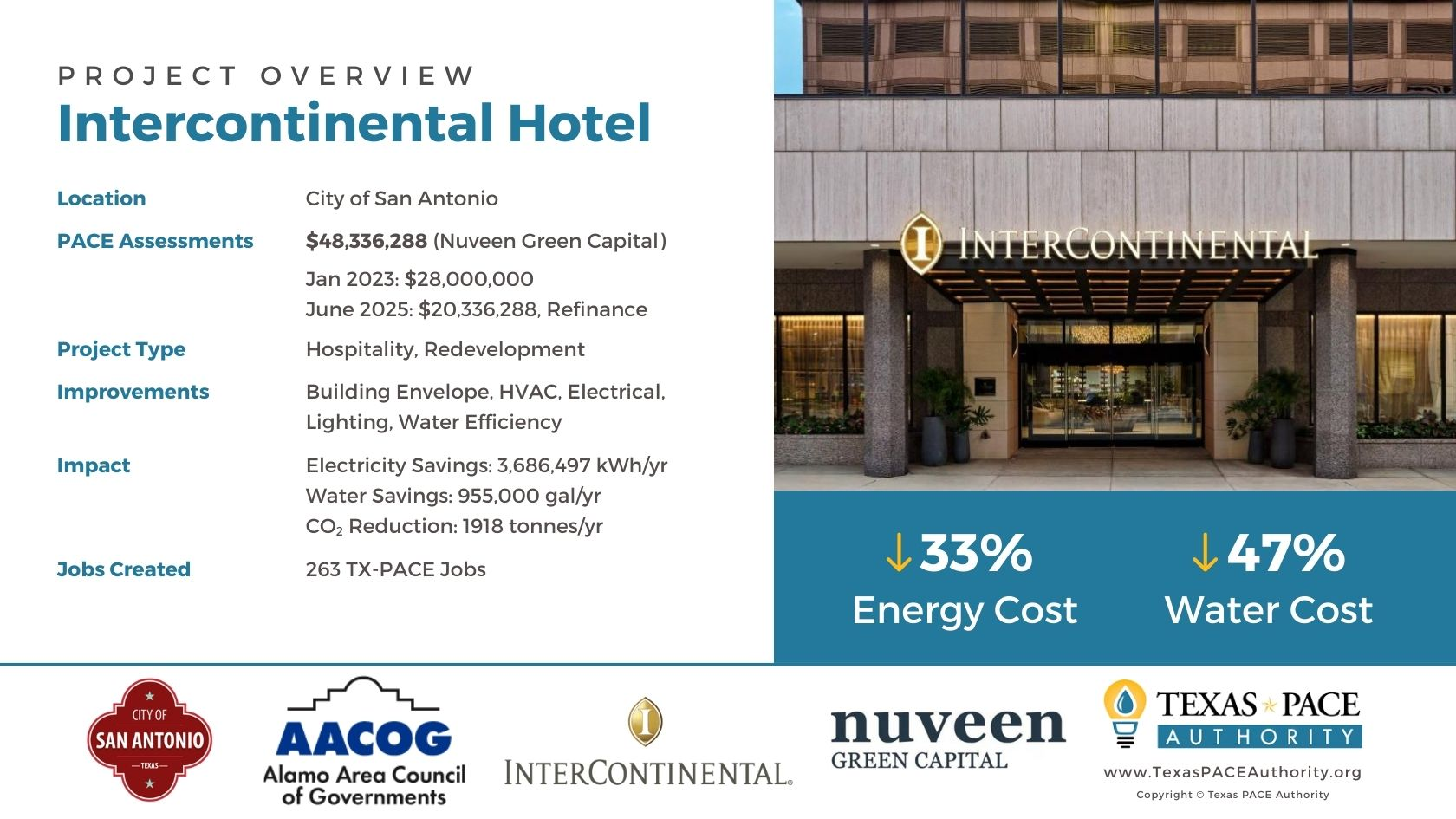
InterContinental Hotel
San Antonio, Riverwalk
A large-scale hospitality project that incorporated TX-PACE financing to support high-performance building systems while preserving flexibility within the overall capital stack.
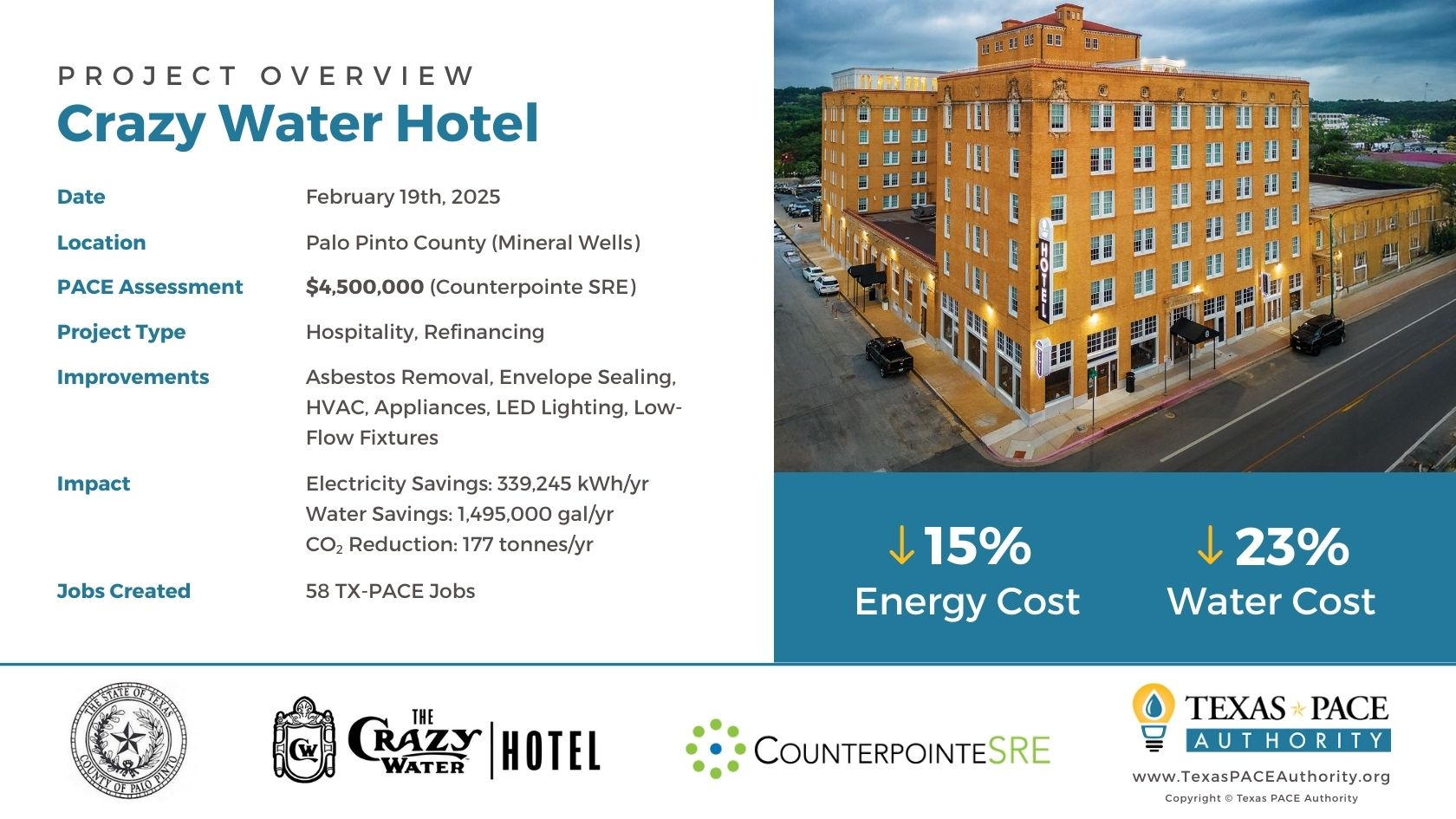
Crazy Water Hotel
Mineral Wells
Historic redevelopment often faces unique financing challenges. TX-PACE helped support modernization improvements while preserving an iconic Texas asset.
These projects vary by geography, size, and asset class, but they share a common reality: traditional financing alone often leaves a gap that requires creative, long-term capital solutions.
Not a Substitute for Discipline but a Response to Market Reality
TX-PACE does not replace prudent underwriting. It does not override market fundamentals. And it does not eliminate the need for equity. What it does is respond to a market where:
- Capital is more expensive
- Leverage is lower
- Risk tolerance is tighter
- And asset needs have not diminished
In that environment, rigid reliance on traditional financing alone often leaves viable projects undercapitalized.
The Bottom Line
The question is no longer whether traditional financing is “enough” in a theoretical sense. The question is whether it is enough in today’s market conditions. For many commercial assets, particularly aging buildings in need of modernization, the answer is increasingly no.
The capital stack is evolving whether the market is ready or not. TX-PACE is one of the tools helping bridge that transition in a way that strengthens asset performance, supports long-term ownership, and aligns financing with how buildings actually operate.
In the next article of this series, we will explore how TX-PACE lowers the cost of capital.
Maturity Wall Series
- Understanding the Maturity Wall
- Why Asset Modernization Matters
- Why Traditional Financing Alone Isn't Enough (this article)
- How TX-PACE Lowers the Cost of Capital (coming next)
About Texas PACE Authority
Texas PACE Authority (TPA) is a nonprofit organization and the leading administrator of TX-PACE programs serving 112 cities and counties across Texas. TPA works with local governments, property owners, and capital providers to facilitate financing for energy and water efficiency, resiliency, and distributed generation improvements in commercial properties. Through its program administration and market leadership, TPA helps ensure that high-performance building solutions are accessible, scalable, and aligned with the long-term needs of Texas communities.