
Rebuilding the Capital Stack in Today’s Market: Where TX-PACE Is Reshaping Deal Structure
Second in our “maturity wall” series
As commercial real estate continues to navigate a higher-for-longer interest rate environment, tightening credit standards, and a wave of loan maturities, capital structure is being redefined in real time. The traditional stack, senior debt, mezzanine financing, preferred equity, and sponsor equity, is no longer functioning the way it did in the last cycle.
In many transactions today, gaps are widening between what lenders are willing to provide and what projects actually require to move forward. That gap is precisely where TX-PACE is increasingly stepping in.
The Capital Stack Is Changing—Not Gradually, but Structurally
For years, the commercial capital stack followed a familiar hierarchy:
- Senior debt provided by banks or CMBS lenders
- Mezzanine debt filling leverage gaps
- Preferred equity bridging remaining shortfalls
- Sponsor equity absorbing residual risk
That structure assumed abundant liquidity and relatively cheap capital at every tier. Today, that assumption no longer holds.
As discussed in the first blog in this series on the “maturity wall,” a significant portion of commercial real estate debt is reaching refinancing windows at exactly the wrong time in the cycle. Underwriting constraints have tightened while asset valuations have adjusted downward in many sectors. The result is a structural mismatch: projects that were once fully financeable now sit in limbo due to equity gaps that mezzanine and preferred equity are not efficiently solving.
Where TX-PACE Fits in the Modern Stack
This is where TX-PACE is increasingly being used as a structural replacement, not a supplement, for higher-cost capital layers.
In a rebalanced capital stack, TX-PACE financing typically sits:
- In front of senior mortgage debt
- Secured by a voluntary assessment on the property
- Senior to equity in the repayment waterfall
But its true role is not simply positional. It is functional.
TX-PACE converts eligible energy efficiency, water conservation, resiliency, and infrastructure improvements into long-term, fixed-rate, non-recourse capital that is securitized through the property tax assessment mechanism. Because of this structure, it behaves less like traditional debt and more like utility-grade infrastructure financing.
The practical impact is significant: TX-PACE can often replace mezzanine debt or preferred equity that would otherwise be required to bridge a financing gap.
Replacing Expensive Capital, Not Competing With Senior Debt

One of the most important clarifications in today’s market is this: TX-PACE does not compete with senior lenders, it complements them.
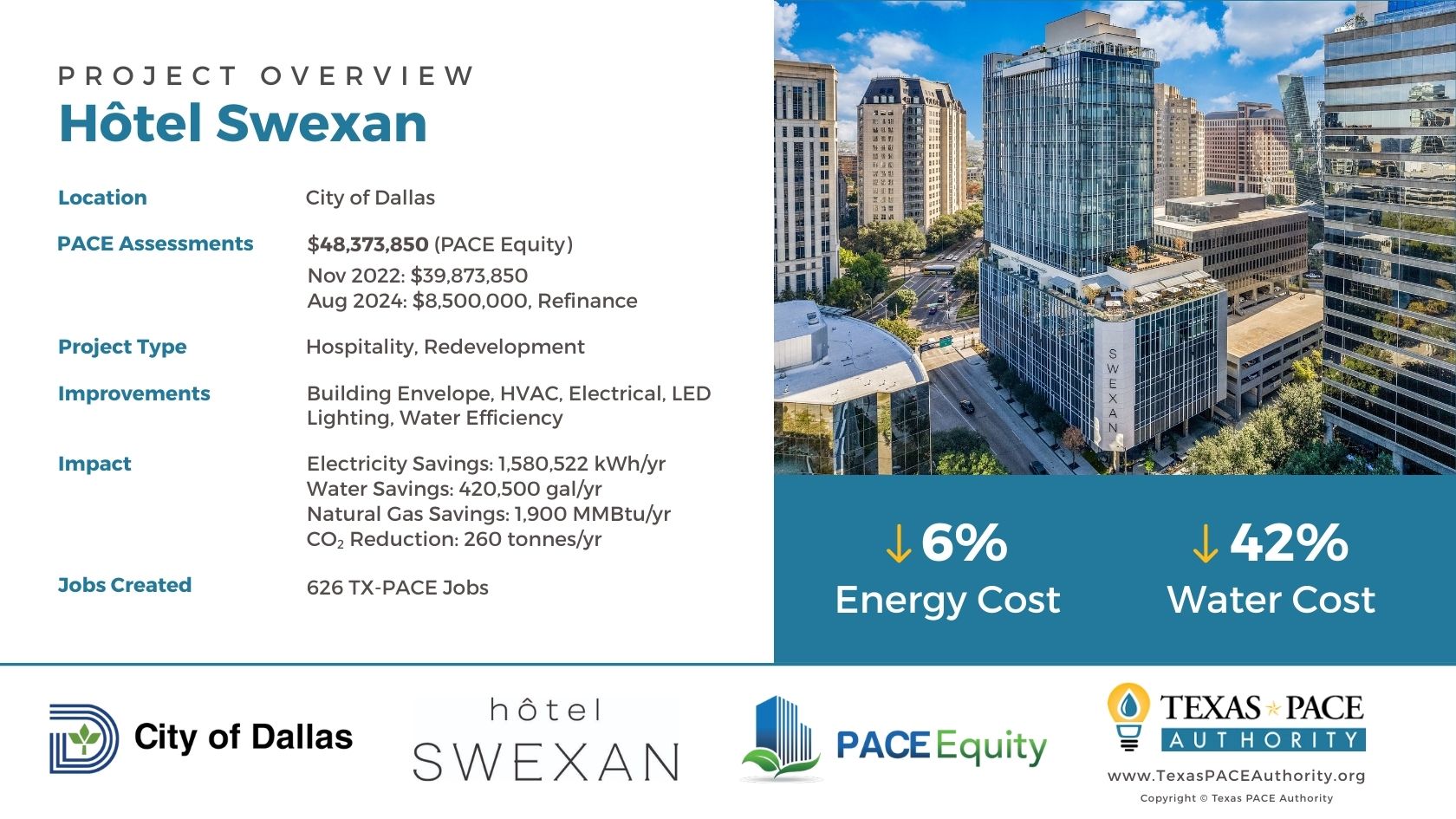
This approach is increasingly being adopted in institutional-quality developments as well. City of Dallas’ Hôtel Swexan (pictured right) incorporated TX-PACE financing as part of its capital structure to support high-performance building systems and long-term operational efficiency. The project reflects the growing role of TX-PACE in helping large-scale developments reduce reliance on higher-cost subordinate capital while enhancing long-term asset performance.
Senior lenders benefit from:
- Reduced operating expense volatility
- Improved asset performance metrics
- Lower refinance risk due to stabilized cash flows
At the same time, developers and owners benefit by:
- Reducing or eliminating mezzanine financing
- Avoiding dilutive preferred equity structures
- Preserving sponsor control and upside

In many cases, TX-PACE allows a transaction that was previously “unfinanceable” under today’s underwriting standards to become viable again, without forcing additional equity into the deal.
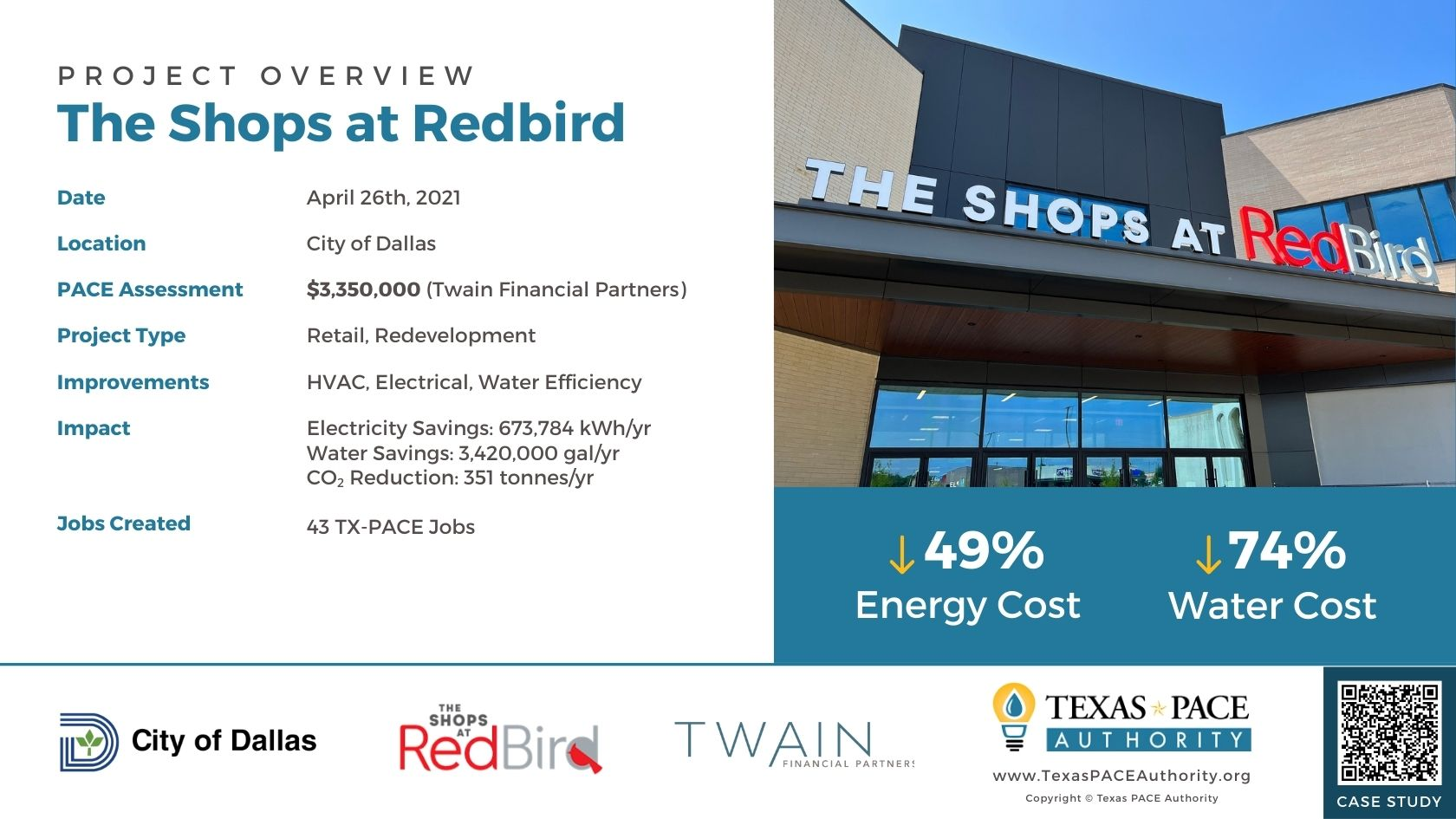
Projects across Texas are already demonstrating this shift in practice. In Dallas, the Reimagine RedBird redevelopment (pictured right) utilized TX-PACE financing to support major infrastructure and building performance improvements as part of the broader repositioning of a legacy mixed-use asset. By aligning long-term infrastructure investments with long-term financing, the project illustrates how TX-PACE can help bridge capital gaps while preserving development flexibility.
Why Mezzanine and Preferred Equity Are Under Pressure
Mezzanine and preferred equity once served as flexible tools to bridge capital shortfalls. In the current environment, however, they present three key challenges:
- High Cost of Capital
Returns demanded by mezz and preferred equity investors have increased significantly. - Shorter Investment Horizons
These layers often require earlier exit or refinance assumptions that are harder to achieve in today’s liquidity environment. - Increased Refinancing Risk
As senior debt tightens, refinancing subordinate capital becomes more uncertain.
TX-PACE addresses these issues by replacing portions of that capital stack with long-term, asset-backed financing that is tied to the building’s performance rather than market timing.
The Maturity Wall Effect: Why This Matters Now
The convergence of maturing loans and tighter underwriting has created a reset moment for commercial real estate capital structures.
Owners are being forced to answer difficult questions:
- How do we refinance at today’s valuations?
- Where do we fill equity gaps without over-dilution?
- How do we improve DSCR under stricter lender requirements?
TX-PACE is increasingly part of the answer, not as a niche tool, but as a structural component of modern deal design. By converting capital-intensive upgrades into long-term, self-amortizing obligations, TX-PACE improves both cash flow and credit profile at the asset level.
Rebuilding the Stack for Long-Term Resilience

The capital stack is not disappearing, it is being rebuilt.
The emerging structure in many TX-PACE-enabled deals looks more like this:
- Senior mortgage debt (recalibrated and more conservative)
- TX-PACE financing (long-term, performance-backed capital)
- Reduced or eliminated mezzanine layer
- Leaner sponsor equity requirements
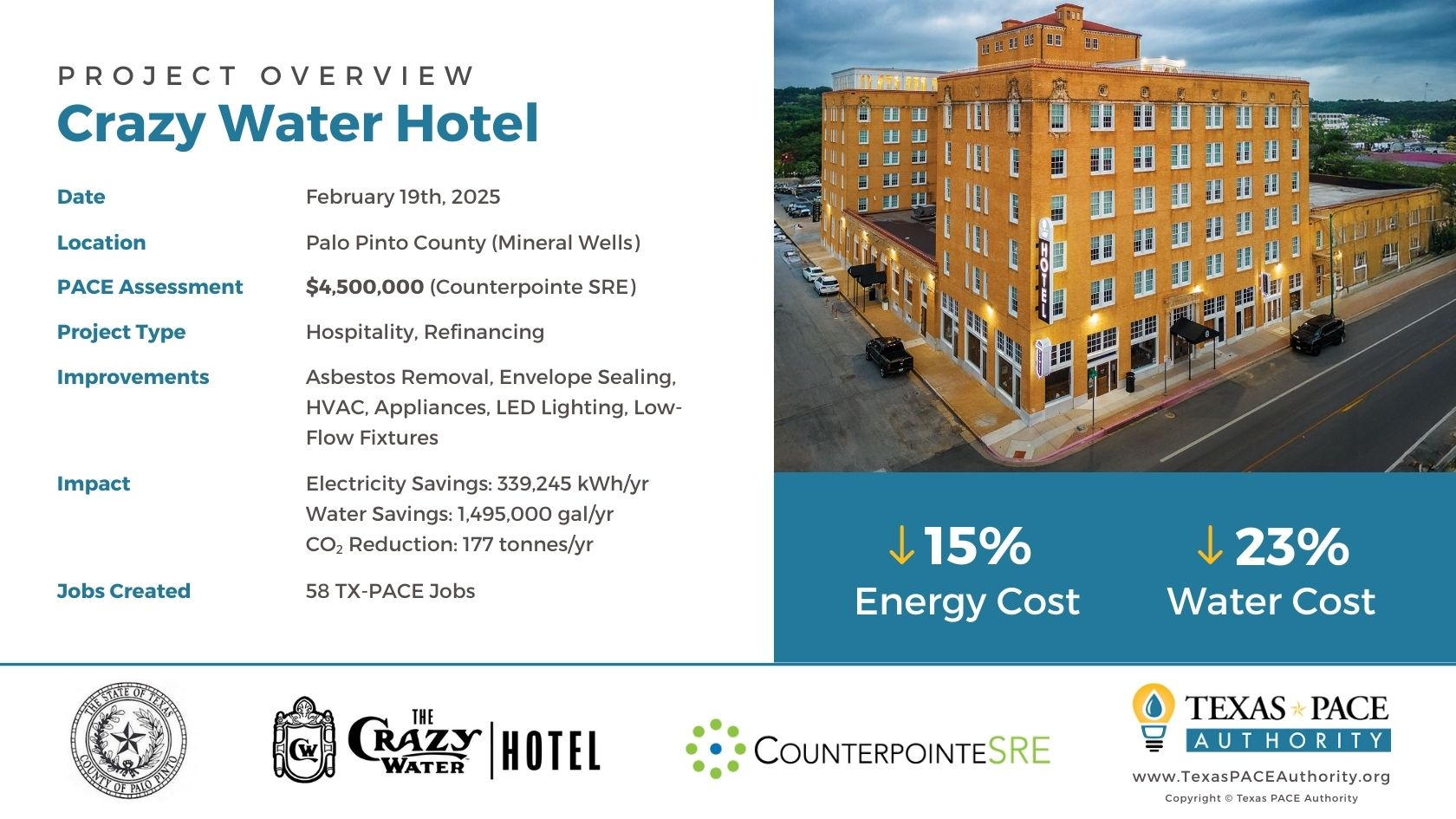
Historic redevelopment projects are also benefiting from this evolving capital approach. The redevelopment of the Crazy Water Hotel (pictured right) in Mineral Wells utilized TX-PACE financing to modernize aging infrastructure while supporting the long-term economic revitalization of a historic downtown asset.
This is not a temporary adjustment. It reflects a broader shift toward infrastructure-aligned real estate finance, where building performance and capital structure are increasingly linked.
Looking Ahead
As more assets cycle through refinancing over the next several years, the question is no longer whether the capital stack will change but how quickly do owners and capital providers adapt to that change.
TX-PACE is proving to be one of the few tools that align lender priorities, owner economics, and long-term asset performance within a single structure.
In the next installment of this series, we will explore why traditional financing alone is no longer enough in today’s market and how tightening credit and rising capital costs are reshaping what it takes to get deals done.
About Texas PACE Authority
Texas PACE Authority (TPA) is a nonprofit organization and the leading administrator of TX-PACE programs serving 111 cities and counties across Texas. TPA works with local governments, property owners, and capital providers to facilitate financing for energy and water efficiency, resiliency, and distributed generation improvements in commercial properties. Through its program administration and market leadership, TPA helps ensure that high-performance building solutions are accessible, scalable, and aligned with the long-term needs of Texas communities.